Legal Requirements to Sell a House in Virginia
Legal Requirements to Sell a House in Virginia
Under the Virginia Residential Property Disclosure Act, sellers must provide a residential property disclosure statement, informing buyers that the home is sold "as is" unless specific disclosures apply. Sellers also need a signed purchase agreement, accurate title transfer, and settlement through a licensed closing agent. WeBuyNOVA simplifies this by purchasing Northern Virginia homes as-is, handling closing costs directly.
Key Takeaways
- Virginia requires sellers to disclose all known property defects to buyers in writing before sale completion.
- Sellers must transfer tenant security deposits to buyers or return them within 45 days under Va. Code § 55.1-1226(E).
- A valid deed must be recorded with the local circuit court to complete the property transfer legally.
- Sellers in Virginia must provide buyers with a Property Owners' Association disclosure if applicable to the property.
What Legal Paperwork Does Virginia Require to Sell?
Virginia home sales run on codified statutes found in the Code of Virginia, not informal custom. These statutes govern how real property changes hands across the Commonwealth, from Loudoun County to the Hampton Roads region. Every seller preparing paperwork should treat these rules as the baseline, since skipping a required form creates legal exposure long after closing.
Meeting the legal requirements to sell a house in Virginia means assembling several documents before a buyer ever signs. The purchase contract sits at the center, but it works alongside disclosure forms, deed records, and closing statements. Missing any one piece slows the transaction and risks disputes down the road.
Does Virginia law require a real estate attorney to sell a home?
No. Virginia house sale law does not mandate hiring an attorney to complete a residential sale. Many sellers still choose one for complex situations, such as inherited property or title complications. For a straightforward FSBO sale, a title company or settlement agent can often handle the closing paperwork instead.
Understanding virginia property sale laws fully requires looking at four categories together, not in isolation:
- Cost obligations, including taxes and closing fees tied to the sale
- Disclosure duties, covering what sellers must tell buyers about the property's condition
- Timeline requirements, from contract signing through deed transfer
- Market factors, which vary significantly between Northern Virginia and other regions
Sellers in Alexandria, Arlington, Fairfax, Loudoun, and Prince William counties each face the same statutory framework. Local practices around title companies and settlement timing differ by county. A cash buyer familiar with Northern Virginia's specific paperwork expectations can help a FSBO seller avoid the most common filing mistakes, including incomplete seller disclosure va forms or missing deed documentation at settlement.
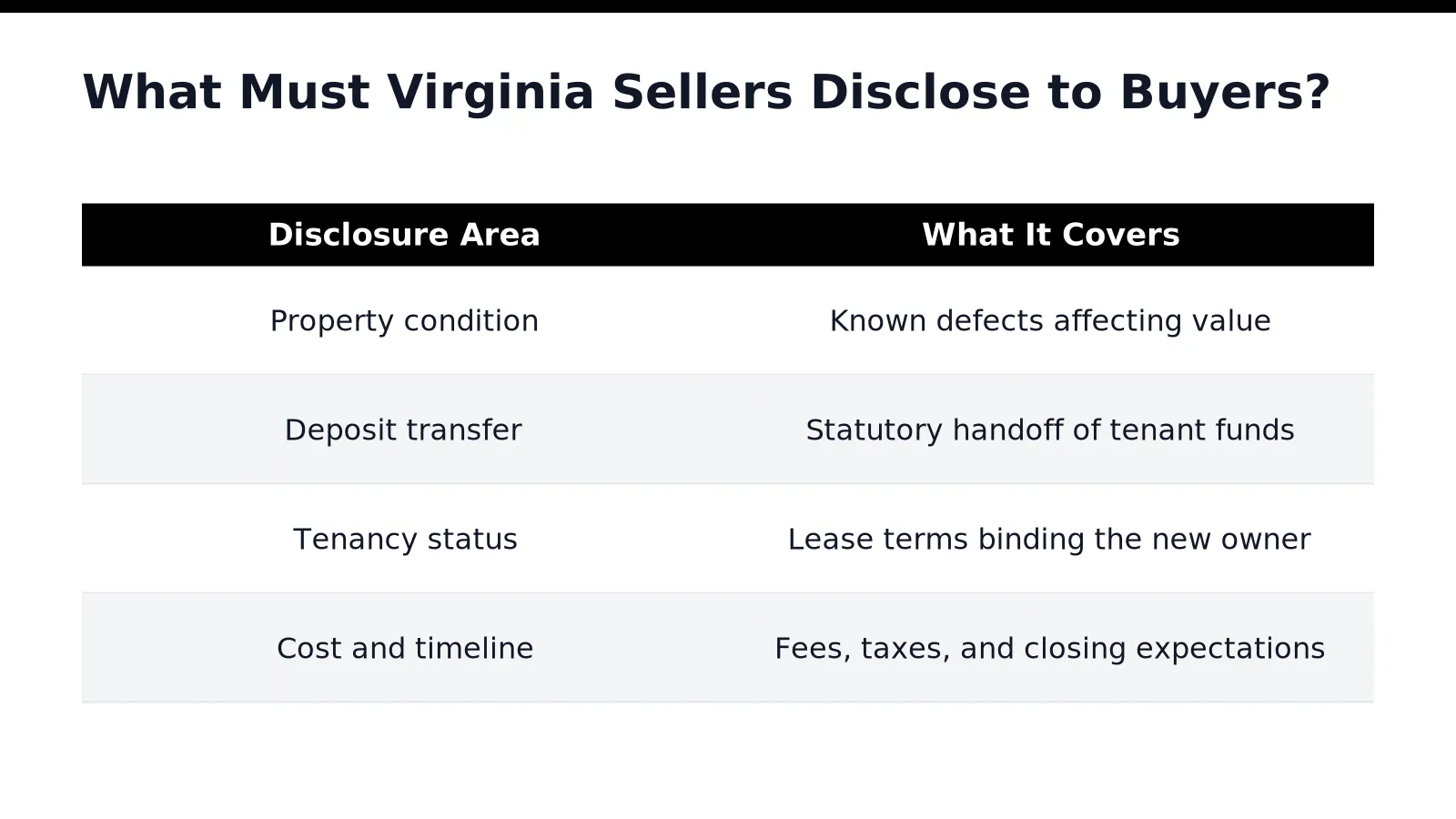
What Must Virginia Sellers Disclose to Buyers?
Virginia sellers must disclose far more than the physical condition of a property. The legal requirements sell house transactions carry in Virginia touch cost, timeline, market context, and, when tenants live in the home, landlord-tenant law itself. Homeowners in Northern Virginia preparing an FSBO or as-is sale need a clear map of these obligations before signing anything.
Seller disclosure VA rules extend into financial territory that many homeowners overlook. Selling a home involves cost disclosures, timeline expectations, and market nuances that shape what a buyer can reasonably expect from the deal. A seller who skips these details risks disputes after closing, not just before it.
Tenant-occupied properties raise the stakes considerably. Selling a home with renters still living there is not treated as a simple transfer of title. Virginia law classifies it as a regulated landlord-tenant event. That distinction matters because virginia house sale law imposes obligations a vacant-home sale never triggers.
What happens to a tenant's security deposit when the house sells?
Virginia sets a specific statutory rule for this exact situation. Under Virginia Code, the deposit-transfer requirement controls how a departing owner must handle funds already held on a tenant's behalf. Sellers cannot simply pocket the deposit or ignore it during closing.
Does the buyer inherit the lease and tenant obligations?
Yes. A buyer who purchases an occupied property automatically becomes a successor landlord under Virginia's residential landlord-tenant act. This shift carries real consequences for virginia property sale laws around notice and tenancy termination.

What Taxes and Closing Costs Apply in Virginia?
Virginia sellers face a grantor tax, state income tax on profit, and a bundle of closing fees that together shape net proceeds. The grantor tax runs 0.50% statewide, but climbs to 0.65% for properties inside Northern Virginia. That half-point jump reflects the region's higher transaction volume and value, not a separate rule.
State income tax adds another layer. Profit from a home sale can be taxed at rates up to 5.75%, depending on income bracket. Sellers in Sterling, Loudoun County, or Fairfax County should run these numbers before setting a listing price, since the tax hits sale proceeds directly.
How much does it cost to sell a house in Virginia?
Total selling costs in Virginia typically range around 8.6% of the sale price, including taxes, fees, and closing charges. That figure covers the grantor tax, state income tax exposure, and standard transaction costs, not commissions alone.
Why does Northern Virginia pricing behave differently?
Proximity to Washington, D.C. makes Northern Virginia one of the most competitive, highest-value commuter housing markets in the country. That demand pushes home prices upward, which means the 0.65% grantor tax often applies to a larger sale figure than in other parts of the state. Sellers weighing a traditional listing against a cash sale should factor these virginia property sale laws into their timeline. A faster closing reduces carrying costs that eat into that 8.6% margin. WeBuyNOVA covers standard closing costs for homeowners selling across Virginia, which removes one major variable from this calculation.

Selling a Tenant-Occupied Home: What Are the Rules?
Tenant-occupied properties in Virginia carry landlord-tenant obligations that follow the house through closing. A sale does not erase a lease. It transfers the landlord's duties to whoever buys the property next.
Virginia homeowners meeting the legal requirements to sell a house with renters inside need to treat the transaction as more than a standard closing. Virginia's Selling a House with Renters guide (2026) describes this directly: a tenant-occupied sale functions as a regulated landlord-tenant event, not a simple property transfer. That distinction shapes notice periods, lease handling, and deposit transfers alike.
Does selling the house end the tenant's lease?
No. A fixed-term lease runs until its stated end date, regardless of who owns the property. Under the Virginia Residential Landlord and Tenant Act, the new owner becomes a successor landlord, stepping into every obligation the seller once held.
How much notice does a month-to-month tenant get?
Ending a month-to-month tenancy before closing requires written notice of at least 30 days before the next rent due date, per Virginia Code Section 55.1-1253. Week-to-week arrangements follow a shorter timeline, so owners should confirm the tenancy type before issuing any notice.
Security deposits add another layer under virginia house sale law. Virginia Code Section 55.1-1226(E) sets a defined transfer process sellers must follow at closing, rather than leaving deposit handling to informal agreement between buyer and seller.
Sellers who skip these steps risk disputes that delay closing and expose them to liability under Virginia property sale laws.
Is a Cash Sale the Simplest Legal Path?
A cash sale removes several steps that typically slow down the legal requirements for selling a house in Virginia. Buyers who pay cash purchase the property as-is. Sellers avoid repair negotiations, staging costs, and the back-and-forth that often follows a home inspection. Fewer moving parts mean fewer chances for a deal to fall apart over compliance questions.
Speed matters here too. A cash transaction can close in as little as 7 to 14 days, which shortens the window during which disclosure and contract obligations remain open. The longer a sale drags on, the more opportunities exist for disputes under Virginia house sale law to surface.
Does a cash sale skip seller disclosure requirements?
No. Seller disclosure in Virginia still applies, regardless of how the buyer pays. Cash buyers simply tend to move through those disclosures faster because fewer contingencies and lender conditions stand in the way.
Selling as-is also protects a homeowner's wallet. Skipping repairs saves both time and out-of-pocket expense, two costs that often balloon under traditional Virginia property sale laws involving financed buyers and lender-required inspections.
For homeowners across Northern Virginia, WeBuyNOVA, based in Sterling, VA, provides direct cash buying solutions designed around this simpler path:
- No repairs or staging required before closing
- Closings possible within 7 to 14 days
- Fewer contingencies tied to lender compliance steps
- As-is purchase terms that reduce negotiation delays
For sellers juggling tight timelines or inherited property, a cash sale offers a straightforward, legally sound route to the closing table.
FAQ
What disclosure requirements must Virginia sellers provide?
Virginia requires sellers to provide a residential property disclosure statement under the Virginia Residential Property Disclosure Act, informing buyers the home is sold "as is" unless specific disclosures apply. Sellers must disclose all known property defects in writing before sale completion.
Does Virginia require a real estate attorney to sell a home?
No, Virginia law does not mandate hiring an attorney for a residential sale. A title company or settlement agent handles closing paperwork for straightforward FSBO sales. Sellers with complex situations like inherited property often choose one anyway.
What happens to tenant security deposits when selling a rental property in Virginia?
Sellers must transfer tenant security deposits to buyers or return them within 45 days, as required under Va. Code § 55.1-1226(E). This applies specifically when selling rental property with existing tenants in Virginia.
Conclusion
In closing, selling a house in Virginia requires understanding disclosure obligations, title requirements, and the closing process, each step designed to protect both buyer and seller. By familiarizing yourself with these legal foundations, you approach your transaction with confidence and clarity. Whether you work with a realtor, attorney, or explore alternative selling methods, knowing what Virginia law demands ensures your sale proceeds smoothly and protects your interests throughout.